

Our Policy Lead, Stephen Caulfield, explores what the parties are promising on neurodivergence
On Thursday, voters across the U.K. head to the polls for what is shaping up to be an era-defining set of local and parliamentary elections. In Scotland, 129 MSPs will be elected to the Scottish Parliament, each with responsibilities for scrutinising and voting on legislation that will impact on each of us for years to come. Here we reflect on our own hopes for the 7th parliamentary session, the political parties’ manifestos, and what that all means for neurodivergent people and families.
Even in the relatively short time since the last Scottish parliamentary election in 2021, we have seen a marked increase in both public and political awareness of neurodivergence and the experiences of neurodivergent people, and their salience on Scotland’s political agenda. History shows us that increasing awareness and visibility of marginalised groups drives greater understanding – and with that understanding comes demands for meaningful action.
As Thursday approaches, we reflect on a parliamentary session in which rights issues were front-and-centre – rhetorically, though not always substantively. Scotland’s recovery from the Covid-19 pandemic (and reflection on the inequality that it exposed) dominated the session’s early years. Additional Support Needs (ASN) provision in schools and access to neuro-developmental assessment, and the lack thereof, have featured heavily in political debate more recently as demands on ‘the system’ continue to surge alongside appreciation of the scale of the challenges we face.
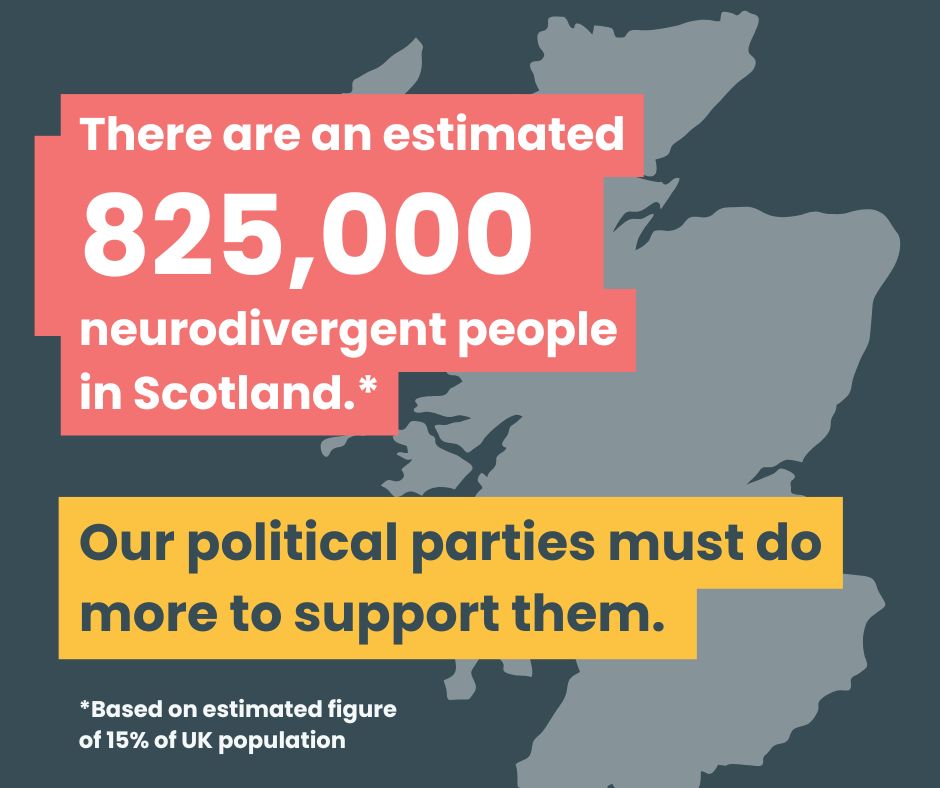
The forthcoming parliamentary session presents Scotland with renewed opportunities to turn awareness into action for the estimated 825,000 neurodivergent people in Scotland today. Whilst our aspirations for the next session of Parliament span several themes, from education to mental health, they are united by their grounding in wellbeing and human rights – and a harsh reality that the rights of neurodivergent people and families will often go unfulfilled.
Though some could certainly go further, we have been pleased to read manifestos which are seized of the need to take decisive policy actions to improve outcomes for neurodivergent people across education, employment, and assessment & support. The next Scottish Government needs to:
- Build a well-resourced, genuinely neuro-inclusive education system that meets all of the needs of all children & young people with social, sensory, and communication differences
- Deliver the Learning Disabilities, Autism and Neurodivergence (LDAN) Bill
- Ensure that every person seeking support and assessment in respect of their neurodivergence can access it – in their community, from a neuro-affirming practitioner, at a time of their choice, and at no cost
‘LDAN’
A Learning Disabilities, Autism, and Neurodivergence (‘LDAN’) Bill remains a key ask across the sector, reflective of the important role that wide ranging primary legislation can have in remedying injustices across education, health, and employment, for instance. We have spoken at length about our support for the Bill and our disappointment that the current Scottish Government did not deliver one in the previous parliamentary session as it promised. We urge the next Scottish Government to move quickly to bring LDAN – draft proposals for which were published in March – to the Scottish Parliament in 2026.
We are pleased that two parties – the Scottish Greens and Scottish Liberal Democrats – make an explicit commitment to introducing ‘LDAN’ legislation. The Scottish Conservatives, whilst stopping short of a clear call for new legislation, recognise the failure to deliver LDAN and state that post-diagnostic supports and reforms to assessment must be included in “any revised proposals”, hinting at a receptiveness to LDAN legislation. Scottish Labour takes a similar stance, in that they do not call for new legislation but reference the proposed Bill in connection to proposals they make around inclusive communications. Disappointingly, and despite doing so in 2021, the SNP does not commit to an LDAN Bill; nor does Reform UK Scotland.
Education
Education was and remains the key focus of the Trust’s service provision. The range of challenges that neurodivergent learners and their families face – from misuse of restraint and seclusion and ad hoc part-time timetabling to a lack of reasonable adjustments and neuro-inclusive environments – necessitates bold action.
SLC, our Grant-Aided school, utilises a ‘wellbeing curriculum’ that is focused on good mental health, social-emotional learning, and pupil voice as the foundation of achievement. Our education offer prioritises holistic, inclusive success measures over traditional academic standards, recognising that the many journeys to success are as diverse as the pupils taking them. We want to see this replicated, to as great an extent as practically possible, in mainstream schools across the country.
We were pleased to see that each party’s education policies featured proposals that would benefit neurodivergent children and young people. Skill-based alternatives to assessments and pathways into vocational training, for instance, are a recognition and accommodation for difference; no two minds are the same, so we must not assume that all pupils will follow one set educational journey. Reform UK Scotland’s proposals around a new pathway for S3/S4 students in “alternative, technical education” chime with greater access to experiential learning, and we would be interested to see more details from them on that. Similarly, we support Scottish Conservative and Scottish Liberal Democrat plans for a strategy and new legislation on Youth Work.
The Scottish Greens propose an end to examination at National 5 level and the full implementation of the Hayward Review more generally. Overall, the Scottish Green proposals on education are perhaps the most encouraging, for example: capping class sizes at 20, a ‘Scottish Diploma of Achievement’, and a review of the role of Co-ordinated Support Plans (CSPs).
The SNP manifesto is especially thin on education, though the recently published McManus Review does make an appearance, highlighting a willingness to take forward the recommendations after they, in all likelihood, return to government come mid-May. This is positive.
The Liberal Democrats’ proposal to produce guidelines on reasonable adjustments for schools, alongside actions like hiring 2,000 more pupil support assistants (PSAs) and rolling out more specialist support such as speech and language therapies, would make education more accessible for neurodivergent learners. Training for teachers is part of this, too, and Scottish Labour have pledged to implement “new widespread training” on neurodiversity and additional needs for school staff.
Mental Health
Reform to mental health law – the removal of learning disability and autism from the scope of the Mental Health (Care and Treatment) (Scotland) Act – has been a priority of the Trust in recent years. We were disappointed to see that none of the parties have committed to implementing the recommendations of the Rome Review in this election cycle, however. Conversations with individual MSPs have shown that there is an appetite for this in principle (the Scottish Greens have previously made noises to that end) and so it will be incumbent on the Trust and others to press for neuro-inclusive law reform in the new session.
Where the parties have had much to say is in the role of community ‘hubs’ in supporting those experiencing mental ill-health – something which disproportionately impacts neurodivergent people. All five of the parties currently represented in Holyrood commit themselves to roll out walk-in mental health hubs modelled on SAMH’s ‘Nook’ centres. We support that.
The SNP have made financial commitments to school counselling and a ‘Crisis Intervention Fund’ for emergency mental health responses. Labour have said similar on emergency care, while reaffirming commitments to annual health checks for people with learning disabilities (something long promised but not rolled-out at pace by the current government). The Liberal Democratics promise year-on-year real terms increases to mental health budgets and the abolition of ‘rejected referrals’.
The Scottish Greens have committed to ensuring that getting support in education, work and access to social security benefits is not dependent on diagnosis of conditions, which is vital at a time when we see length waiting times for mental health care and neuro-developmental assessment.
Assessment and Support
There is now a clear consensus amongst the parties of the need for reform to neuro-developmental support, including assessment. The Donaldson Trust is supportive of a stepped care, ‘pathways’-style approach, as proposed by the Royal College of Psychiatrists; therefore, we were pleased to read that many of the Scotland’s parties are supportive of this, too. Long term planning from government (with the input from neurodivergent people, charities experienced in supporting neurodivergent people, and healthcare professionals) is needed to meet the significantly increased demand for neuro-developmental assessments. A holistic approach, where assessment is one part of a wider, person-centred support system, is essential. Every neurodivergent person deserves inclusive, accessible support on their own terms.
The Scottish Liberal Democrats have perhaps the most well-developed suite of proposals on assessment (which include commitments on ‘shared care’ agreements and national standards for assessment) and are the only party that has committed to collecting and publishing data on waiting times for neuro-developmental assessment. The SNP commit to the Royal College’s own proposal, with Scottish Labour and the Scottish Greens proposing a very similar national neuro-developmental pathway which would deliver consistent assessment, diagnostic and post diagnostic processes across Scotland. The Scottish Conservative and Reform UK Scotland do not mention assessment and support.
It is encouraging too to see parties pledging to support more neurodivergent people to enter employment, and to support employers to become more neuro-inclusive. The importance of making adjustments to make it easier for neurodivergent people to access and maintain employment cannot be overstated: without them, organisations miss out on incredible talent, unique perspectives, creativity and innovation. Embracing neurodiversity in the workplace benefits everyone.
Finally, it’s clear that Scotland’s parties have high awareness of neurodiversity and topics that are important for neurodivergent people – even if they do not always have the right policy prescriptions. That is certainly a step in the right direction, but we must see real actions to change systems that do not work for every kind of mind.
We look forward to working with newly-elected MSPs across the Holyrood chamber over the next five years to help build a Scotland where neurodivergent people and families are understood, accepted, treated fairly, and valued.


